Designing for Absence
Date
March 3, 2026
Reading Time
11 min
Most design disciplines aim for presence. Ambient intelligence requires the opposite. And almost nothing in design education, research practice, or product development prepares you for that brief.
In most disciplines, presence is the goal. Architecture creates shelter, enclosure, habitation. The building is present. You move through it. It holds you. Industrial design creates objects that communicate through their physical existence. The chair is present. You sit in it. It responds to your weight. Graphic design creates marks that carry meaning. The poster is present. You read it. It communicates.
Ambient intelligence design has a different goal. It designs for absence. Not the absence of function. The opposite. The function is constant, continuous, quietly comprehensive. But the function itself becomes absent from conscious awareness. The system works by withdrawing from attention while remaining fully operational. This is a strange brief to work from. And almost nothing in design education prepares you for it.
The Inversion Problem
Most of what we know about designing for people is built on a simple premise: the design should be perceptible. Visible, legible, interpretable. The user should be able to understand what the thing does, how it does it, what state it is currently in. This premise comes from a genuine ethical and practical concern. Technology that operates without being understood is technology that cannot be questioned, corrected, or controlled. Legibility is a form of user agency. Opacity is a form of manipulation.
Applied to a phone, this is correct. Applied to a web application, correct. Applied to a recommendation algorithm, absolutely correct. These are systems where the relationship with the technology is active, ongoing, and consequential. Where the ability to understand what is happening is foundational to the ability to make informed choices.
Applied to ambient intelligence, the premise breaks down. Not because ambient systems should be exempt from ethical scrutiny. Precisely because they are ambient, precisely because they operate continuously in intimate spaces, the ethical requirements are more demanding, not less. The question is whether perceptibility is the mechanism through which those requirements are met. We do not think it is. A system that remains visible in order to remain legible has failed at being ambient. It has succeeded at being present. Which is a different thing entirely.
The challenge is to build systems where the ethical requirements are met through architecture rather than interface. Through what the system structurally cannot do, rather than through what it displays about what it is doing. This is the argument Aerithic develops in Soft Systems, Hard Questions. Here, the focus is narrower: on the design practice required to produce a system that achieves functional absence without ethical absence.
What a Design Language for Withdrawal Looks Like
The conventional design toolbox is built for presence. Contrast, hierarchy, feedback, affordance. Tools for making things visible and understandable. For communicating state, capability, and intent. A design language for withdrawal requires different tools.
Threshold calibration over feedback loops. The conventional design pattern for a responsive system is: action, feedback, confirmation. The user does something, the system responds, the response is confirmed. This keeps the user in a visible dialogue with the system. For ambient intelligence, the pattern needs to be different: observation, calibration, invisible adjustment. The system watches without asking. It adjusts without announcing. The feedback loop runs entirely within the system, not between the system and a visible interface. The design question is not how does the system communicate what it just did, but at what point does any communication cross from ambient attentiveness into obtrusive acknowledgement.
Peripheral expression over central signalling. When ambient systems do communicate, they should do so through peripheral channels. Not screens. Not audio confirmation. Not notifications. Light quality rather than light switching. Thermal gradients rather than temperature displays. Acoustic conditions rather than audio cues. Changes that register subconsciously, that improve felt experience without demanding the focusing of attention. This requires an entirely different material palette for feedback. Designers working in this space need to develop fluency with the qualities of light, with the psychoacoustics of ambient sound, with the thermal and haptic channels through which environment communicates below conscious awareness.
Calibrated invisibility over designed invisibility. There is a temptation to design away all perceptibility from the outset. To build systems so restrained that they never register at any level. This produces systems that feel inert rather than ambient. That read as broken rather than calibrated. The difference between a system that feels ambient and a system that feels absent is calibration to the individual threshold of the inhabitant. Just enough perceptibility to generate subconscious trust. Not enough to cross into focused attention. This threshold varies by person, by context, by time of day, by emotional state. Designing for it means designing systems capable of discovering and calibrating to the variable threshold of the specific person in the specific space.
The Pass-Through and the Invisible
In 2025, IDEO published a distinction between pass-through and invisible design paradigms for ambient systems that clarified a tension the industry had been circling without naming.
Pass-through means transparent to the user. The user can always understand what is happening, can always see the system's state, can always interpret its operations. The technology is present but clear. Legible.
Invisible means the technology has genuinely receded from awareness. Not because it is hiding but because it has become environmental. Part of the conditions of the space rather than a system operating within it.
The design approaches for each are completely different. Pass-through requires investment in legibility, transparency, UI design. The better the interface, the better the user's understanding. Invisible requires investment in calibration, threshold research, and the long deployment needed to understand how a specific system fades for specific people in specific spaces. Most product teams default to pass-through because they have the tools for it. UX design as a discipline is almost entirely a pass-through discipline. The methods, the research practices, the evaluation frameworks, the career paths.
All optimised for making technology legible. The invisible paradigm requires different methods. Different timescales. Different success metrics. And a willingness to build products whose success cannot be demonstrated in a user testing session or a two-week beta.
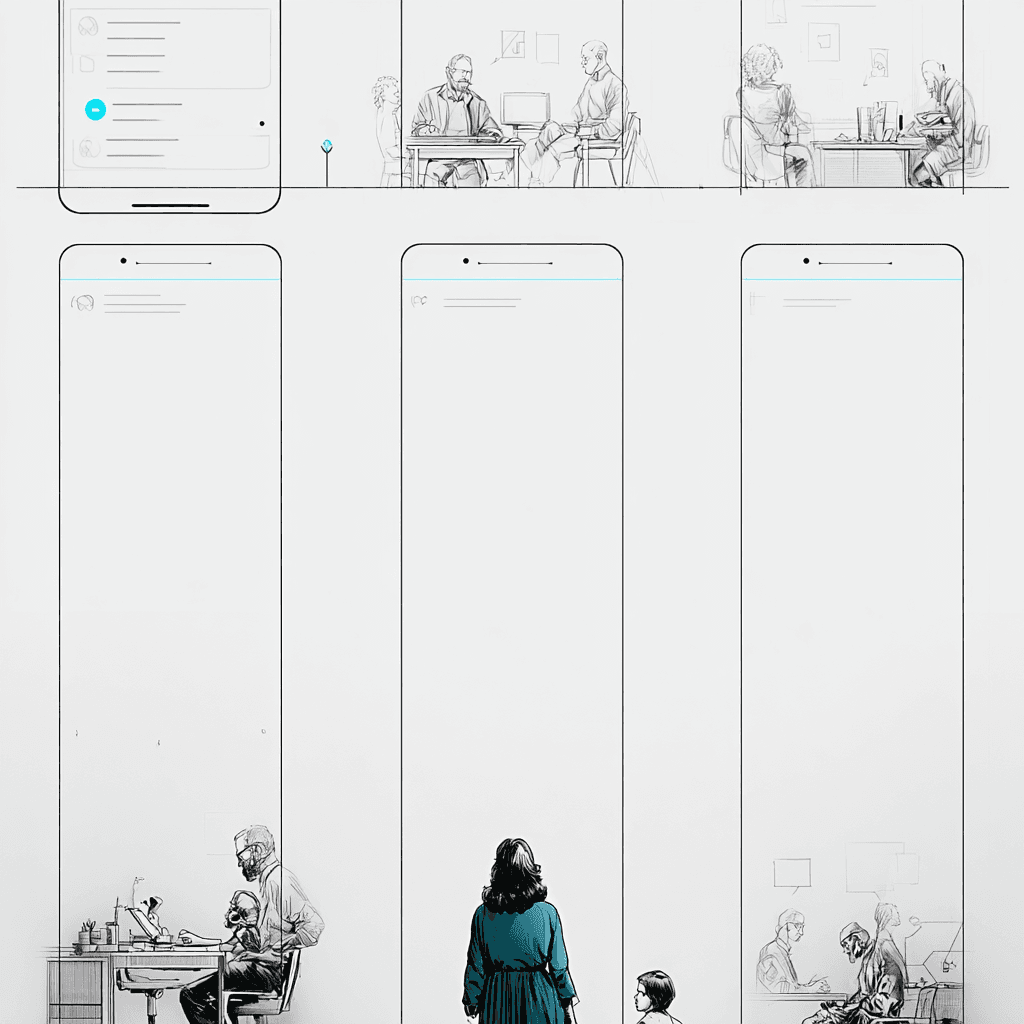
The Material Language of Withdrawal
A conventional device uses visual and material language to communicate capability. Size signals processing power. Ports signal connectivity. Surfaces signal interaction. The device is legible as a device. You can read off its capabilities from its form. An ambient device using the same material language would remain visible as technology. The form would keep asserting itself. Keep demanding that attention confirm and categorise it.
The material language for withdrawal is different. Less obviously technological. Less assertive. Materials that recede into environments rather than standing out from them. Stone, ceramic, dense fabric. Forms that read as belonging in a space rather than being placed in it. The object needs to be present enough to communicate attentiveness. Quiet enough to disappear once that communication is established. This is an extremely fine calibration. Err too far toward restraint and the object communicates nothing. Err too far toward presence and it can never achieve the withdrawal required for genuine ambient function.
One of our colloborator industrial designers here at Aerithic, who is working on the physical expressions of Aerithic's devices, has described this calibration problem as designing for the second look.
The first look should register the object as considered, as belonging, as worthy of the space. The second look should be the last one. After that, the object should be invisible. Most products are designed for the first look. The ambient device needs to be designed so that the second look never comes.
Why This Brief Matters Now
The ambient computing market is moving quickly. Edge AI processors capable of running inference locally, without cloud connectivity, are reaching commercial viability. Sub-milliwatt neural processing.
Years of operation from small power sources. Zero round-trip latency. This is the infrastructure moment. The hardware is arriving that makes genuinely ambient, genuinely local, genuinely private intelligence possible at a consumer product price point.
The question is what products get built on that infrastructure. If the product teams building ambient devices apply conventional product design thinking, the outcome is predictable: more capable smart home products.
More responsive assistants. More legible system states. Better feedback loops. Clearer interfaces. That is not ambient intelligence. That is smarter visibility.
The genuinely interesting opportunity is for product teams willing to invert the design premise entirely. To ask not how to make the system more visible but how to make it less so. To develop the methods, the material language, the calibration practices required to design for absence. Those products do not exist yet in any mature form.
The infrastructure for them is arriving. The design discipline for building them is not. That is the gap Aerithic is working in.
References and further reading
John Maeda, The Laws of Simplicity, MIT Press, 2006. Particularly Laws 1 and 2 on reduction and organisation. IDEO, Designing for Ambient Computing: Pass-Through vs. Invisible Paradigms, 2025, ideo.com. Taichi Takashima, Zero-UI: Designing Interactions Without Interfaces, Medium, 2024. Related Aerithic essay: Soft Systems, Hard Questions. Related Aerithic fieldnote: The Moment of Forgetting.